Good Samaritan Regional Rehabilitation Center is the longest established comprehensive rehabilitation facility in Washington, serving East Pierce County and beyond for 70 years. Since 1999, MultiCare Good Samaritan Foundation has helped bridge insurance gaps for clients who are treated as inpatients and often require a high level of doctor intervention, 24-hour nursing care and a combination of therapies.
Community generosity also helps fund education and programs, cementing the center as a regional leader and empowering patients on their journey toward increased function and independence following a serious event or injury.
But it’s the people who make Good Samaritan rehab truly a center for excellence.
The man behind rehab’s peer support and SCI education
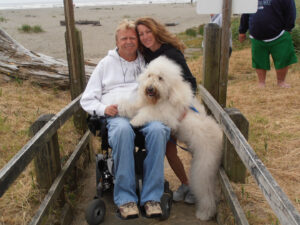
In 1970, Richard “Dick” Sage sustained a spinal cord injury (SCI) from a traffic accident at age 18. He spent a month in bed at a Tacoma hospital before being transferred to Good Samaritan’s Level 1 trauma rehab program.
“That experience at Good Sam was very eye-opening; it was a very positive atmosphere,” Dick recalls. “It renewed hope of maximizing my recovery. The next day or two, I was up in a chair for the first time, so that was liberating.”
The next five months were an emotional rollercoaster. While Dick felt overwhelmed going through this new experience and not knowing what his future would hold, he found camaraderie with other patients who had come from all over Washington for rehab services.
His physical and occupational therapists and nurses were another guiding light on the road to recovery. Physical therapy grew his strength, and occupational therapy focused on upper extremities, introducing tools for improved functionality. With hard work, Dick learned to maximize his abilities and discovered a new meaning of independence.
Several years after discharging from the center, he joined the board for Center for Independence, an independent living center for people with disabilities that started at Good Samaritan by a group of rehab doctors. There, Dick was asked if he could develop a formalized peer support program for individuals who were newly injured, which he’s supervised for over 30 years.
“Something like that would have been helpful to me, and it would have been very helpful to others to be able to see a model of real life outside of the rehab center,” he explains. “I also developed a nine-part series of spinal cord injury education classes covering a variety of different topics from spinal cord injury anatomy and physiology to skin issues; bladder; bowel; psychological adjustment and held those on a regular basis.”
Continuing a legacy of lived experience
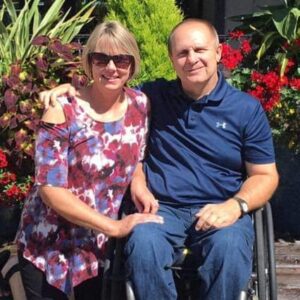
Marty says, “The love and encouragement I’ve received throughout the years from my wife, family and friends have been extremely instrumental in me being a productive and contributing citizen in our community.”
On Dec. 9, 1982, sophomore Marty Wittman was wrestling at Curtis Senior High School when his head hit the mat and his neck gave way. About a week later, MultiCare Tacoma General Hospital performed surgery on his spine. As the 16-year-old healed, he received a call from 18-year-old William Howard. Marty’s future Good Samaritan rehab roommate wanted to give him a warm welcome and, in turn, set the tone for Marty’s recovery there.
For five months, Marty worked toward being as independent as possible at the center. Goals along the way included attending a high school Valentine’s Day dance and continuing driver’s ed with Puyallup School District’s Dave Requa using the program’s adaptive driving vehicle. Marty’s team went above and beyond to see him succeed, as did his family and entire University Place community.
“I also remember just the care on behalf of the staff, just the camaraderie,” he reflects. “When you’re in a facility that long and you’re around the same people every day in a difficult situation, you try to do the best you can with what you got. And the staff were so good at that; we had some really good times.”
Years after his inpatient rehab journey ended, Marty ran into Dick at an SCI support group meeting. The pair formed a friendship, which flourished as Marty became an early peer support volunteer.
“Marty I’ve always been able to count upon, when I would meet with a newly injured individual — someone who I thought Marty would be a good match to meet with,” Dick says.
From his perspective as a peer mentor and former patient, Marty — along with recreation therapist Debbie Jankanish, CTRS/R — recognized the need for a post-discharge group, where people could share experiences, offer encouragement and be in community.
“Debbie is dynamite, a terrific individual, and we tried to put together a spinal cord injury support group,” Marty shares. “Despite our efforts, it just didn’t work because the communication was difficult — it was snail mail or calling people.”
Their dream would be realized in 2012 with the inception of the Here and Now Project.
Picking up the mantle
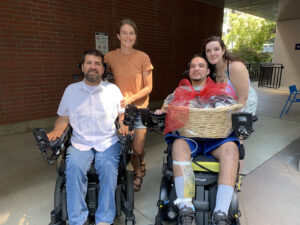
Kenny Salvini (left)
Kenny Salvini is the co-founder and president of the Here and Now Project. His Good Samaritan story began after a 2004 skiing accident left him paralyzed. Following 17 days in Harborview Medical Center’s intensive care unit, and upon arriving at his neighborhood rehab center, reality set in.
“I was 23 — life had just sort of begun,” Kenny says. “Being so young and having my identity so rooted in my physical abilities — it was a massive life shift. And my trajectory and acceptance was slower than most.”
Kenny describes the next two and a half months as a whirlwind of emotions, and he kept Dick — both his peer support coordinator and SCI educator — at arm’s length. He struggled to fully take in Dick’s teachings and push pass a negative mindset.
Still, Dick and rehab staff would leave an indelible mark.
“Back then, Dick had his Tom Selleck mustache and just this beaming personality and really laid-back demeanor, and he had a way of being comforting and not pushy,” Kenny says. “But it wasn’t until years later that I was like, man, what a blessing Dick was.
“Dick and everybody at inpatient rehab is a really upbeat crew, because I think they could see a future for me that I couldn’t see,” he continues.
In terms of his rehab crew, Kenny had an incredible team in Debbie, his physical therapists and his occupational therapists, who found him voice-activated software and assistive technology resources. When discharged, his voice-activated computer became a lifeline, helping him rediscover his voice.
Life after rehab was a “deep, dark hole” spent mostly as a shut-in. That all changed in 2011, when a wheelchair cushion helped Kenny heal from a pressure sore that had kept him bedridden. He was then ready to connect with people who had been where he’d been, and first on his list was Dick. Before long, Kenny joined the ranks of Good Samaritan peer support volunteers and was sharing his ideas for the Here and Now Project.
Here and Now Project
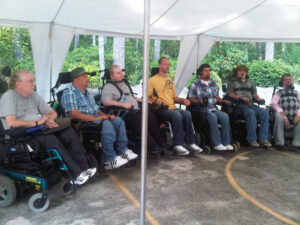
The barbecue that launched the Here and Now Project.
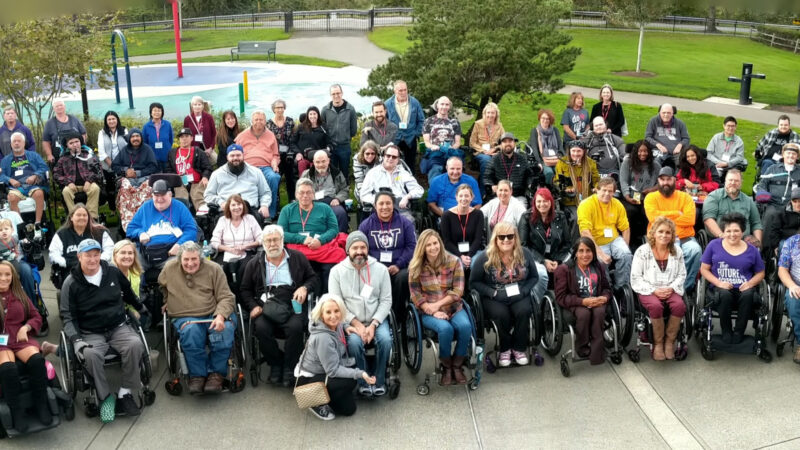
The Here and Now Project seeks to connect and empower the Pacific Northwest paralysis community through support and social groups, community activities and large annual gatherings. Debbie sits on the board of directors, and Dick and Marty are active members.
“In 2012, there’s seven of us sitting at a barbecue under a tent out in Grapeview — all high-level quadriplegics telling different versions of the same story,” Kenny shares. “And that’s when the light bulb went on: We just need to get knee-to-knee with people that have been where we’ve been. It started with barbecues in each other’s backyards, and it’s grown now to just shy of 700 members all over Western Washington.”
The nonprofit also provides care baskets brimming with local and national resources, creature comforts and adaptive swag for the newly paralyzed at Good Samaritan, with a goal of replicating this model in hospitals across the region.
“It allows us to introduce ourselves and put a little seed of hope in the person to let them know that we’re here for them beyond their hospital stay,” Marty explains. “By reaching out, we can help maybe shoulder that pain.”
For Kenny, the project brings strength and hope and builds on the legacy of Good Samaritan rehab’s peer support.
“It’s just about showing people that there’s a rich and meaningful life out there, as long as you can find that one thing that helps you,” he says.
“Dick Sage and Marty Wittman have been doing it for upwards of 40 and 50 years — they were the ones that kind of lit that torch and carried that torch for a very long time,” he continues. “Now, they’re helping ‘light fires’ all over Western Washington.”
Supporting rehabilitation services
Good Samaritan Regional Rehabilitation Center has played a pivotal role in the recoveries of Dick, Marty and Kenny, and later as they returned to support their SCI peers.
“When you look at rehab in a holistic manner, it can really change people’s lives,” Dick shares.
And with donor generosity, the sky’s the limit for the program. Possible philanthropic-powered advancements could include additional specialized staff, increased technology and even an outdoor mobility park.
“Any amount that people can give is helping people find their way back from devastating life changes,” Kenny explains. “I would encourage people to support more and thank them for doing so.”