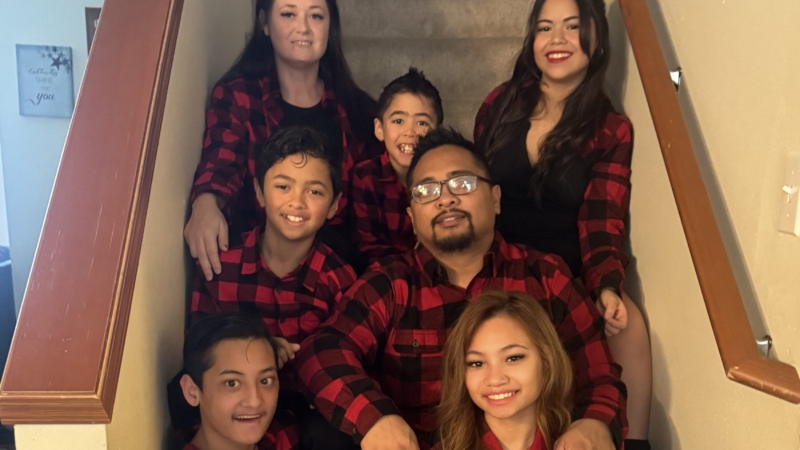

Rodney Jr., 14, and his family are incredibly close. The kitchen is their hub, thrumming with activity as kids assist with cooking duties and everyone enjoys a meal together.
The teen also relishes hanging out with his dad, Rodney Sr., and brothers as they work on their car and motorcycle or play video games.
When Rodney Jr.’s rare genetic disorder regressed last fall, his family was brought even closer, doing everything they could to be there for their son and brother.
Coming together for Rodney Jr.
Rodney Jr. was born with Christianson syndrome, which affects the nervous system. In November 2024, something was off, as he had a low-grade fever, wasn’t talking and kept falling when walking. At donor-supported MultiCare Mary Bridge Children’s Hospital, Rodney Jr.’s team ran numerous tests. Although he appeared fine on paper, he continued to lose his physical abilities.
The team concluded that a recent illness had caused symptoms of his genetic condition to worsen. The regression was severe, leaving Rodney Jr. nonverbal, immobile, requiring a feeding tube and fully dependent on others for all his care needs.
While daunting, Rodney Jr.’s family would meet this new reality together and with resilience.
“Rodney’s family was calm and deeply engaged in seeking the best care for all aspects of Rodney’s wellness — there was never a question of ‘if’ we could meet Rodney’s changing needs but ‘how,’” shares Katie Meyers, MSW, LICSW, an ambulatory float social worker at Mary Bridge Children’s. “Despite the circumstances, they continue to move forward with determination, persistence and selflessness and adaptability.”
To Rodney’s mom Rayna, it’s a team effort in providing a higher quality of life for her son.
“It was a learning experience for all of us,” she says. “We do have six other people in the home, so everyone is participating, and everyone is all about Rodney Jr.”
Navigating a new reality with a helping hand
To best accommodate around-the-clock care for Rodney Jr., his parents made the difficult decision to scale down to one income. With so many life changes occurring simultaneously, Katie quickly connected the family with the donor-powered Helping Hands fund.
“I think of Helping Hands as a bridge to fill the gap between what insurance will cover and what a family can afford when it comes to their child’s care, health and well-being,” she explains. “For some of our families, that gap can be the difference between keeping their child safe, being able to access medical care at all or ensuring that the care they’re provided in our facilities can be maintained at home.”
For Rodney Jr., donations through Helping Hands addressed the most pressing challenge — transportation. Before, the family was reliant on ADA-compliant services that had unreliable schedules and lengthy ride times, resulting in late and missed medical appointments. The donated funds supplied an adaptive car seat, solving the problem immediately and getting Rayna and Rodney Sr. ‘back on track’ in helping their son.
Donor dollars also purchased a floor mat and bed pad to safely assist with sleeping and changing.
“We’re just so grateful for their donations and help for a family like us who went through this dramatic change — it’s not something that was gradually put upon him,” Rodney Sr. shares. “With the donations, it gave us hope, and it gave us belief.”
Rayna echoes her husband’s gratitude.
“A huge thank you from our whole family,” she says. “Things couldn’t go as smoothly as they have gone without all of the help that we have gotten. It’s been a lifesaver.”
Impacting Mary Bridge Children’s social workers
As a social worker, Katie frequently comes alongside families like Rodney Jr.’s during the hardest times of their lives. The weight of that, coupled with large needs, scarce resources and broken systems, can be overwhelming.
Helping Hands steps in here, too.
“To have a tool like Helping Hands that allows us to address critical stressors in a tangible way can often mean the difference between being able to walk away and feel like I was able to make a difference or not,” she explains. “It can bring a sense of relief not only to our families, but to staff as well. Thank you, Helping Hands donors, for being the bridge. You’re making a difference in more ways than you know.”