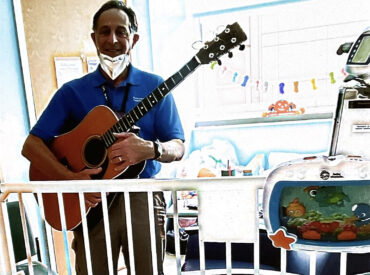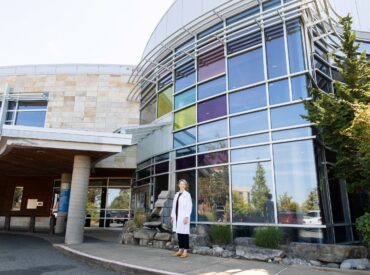
Jaime Garcia, MSW, MultiCare Volunteer Services coordinator for the South King County region, says he’s grateful to God, his wife Dorry and his Pulse Heart Institute cardiologist for seeing him safely through his cardiac care journey.
Jaime Garcia, MSW, is living proof that routine checkups save lives.
At his 2014 annual physical exam, Jaime learned he had a heart murmur. His primary care physician referred him to the donor-powered Pulse Heart Institute, where Jaime became well acquainted with board-certified cardiologist and MultiCare Good Samaritan Foundation board member Uma Krishnan, MD.
“She is tenacious, she is thorough and ended up saving my life,” Jaime says of Dr. Krishnan. “I didn’t know what a heart murmur was when she started, but I felt as though I was in competent hands. I felt very secure.”
During this first appointment, Dr. Krishnan discovered that Jaime had a valve issue. This can interfere with normal blood flow through the heart. She continued to monitor his condition, and in 2018 determined that his valve would need to be replaced via open-heart surgery.
“The surgery is like having a valve job done on a car — you get more efficient firing and more efficient use,” Jaime explains. “With two titanium heart valves replaced, you get more oxygenated blood into the bloodstream. In February 2019, I went through an open-heart surgery, and zoom, within three months I was feeling stronger.”
Coming full circle at Pulse
Post-procedure, Jaime began going to Pulse Heart Institute Cardiac and Pulmonary Rehabilitation – Auburn.
There, he noticed the amazing staff and nurses assisting him with exercises were busy with several other tasks, like wiping down equipment. When he later joined MultiCare Health System as the volunteer services coordinator for the South King County region, this Pulse experience remained in the back of his mind.
Today, Jaime is to credit for bringing the cardiac rehab volunteer assignment into existence to help Pulse staff focus their time on providing the best possible care for patients.
Nazaha Dhillon is the program’s first volunteer.
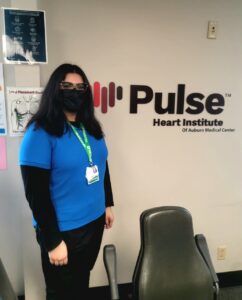
Nazaha Dhillon volunteers her time at Pulse Heart Institute Cardiac and Pulmonary Rehabilitation – Auburn.
“In 2014, my grandmother passed away from a heart attack, and I wanted to become something in the health care system to help with preventative care,” Nazaha shares. “I’ve also been wanting to volunteer at a hospital for years, and I love the atmosphere and how friendly everyone is and how it’s just like a little community as soon as you go through the doors.
“The employees have been trying to help me learn a little bit, too, like showing me EKGs and how different equipment works, as well as the equipment’s purpose,” she continues. “It’s been really exciting.”
Lead clinical exercise physiologist Lindsay Olsen, BS, ACSM-CEP, CCRP, is already thankful for Nazaha’s addition to the team.
“We know that on the day we have our volunteer, the day will be easier for staff, which ultimately improves our patient experience,” Lindsay says. “With the equipment ready to go because of Nazaha, there are less wait times for patients to switch from one piece of equipment to the other. It’s also given patients one more friendly face to start their session.”
The future of cardiac care
Jaime views the Auburn cardiac rehab volunteer assignment as a pilot that will eventually grow across the Puget Sound region. He hopes that down the road there will be an opportunity for volunteers to take on an advisory committee role, helping patients navigate the fear and anxiety of an upcoming heart procedure or surgery.
Jaime also knows that the future of our communities’ heart health is linked to donor generosity.
“Heart issues for my generation and for men in general — it’s a pretty big issue,” he explains. “Donating to Pulse is a good investment because you’re investing possibly in yourself; you never know when you get that physical and discover you may need Pulse. It’s like you’re planting trees that you may never sit under, but this is an investment I know will pay off in the future as we reduce heart disease.”